These products solve different ownership problems
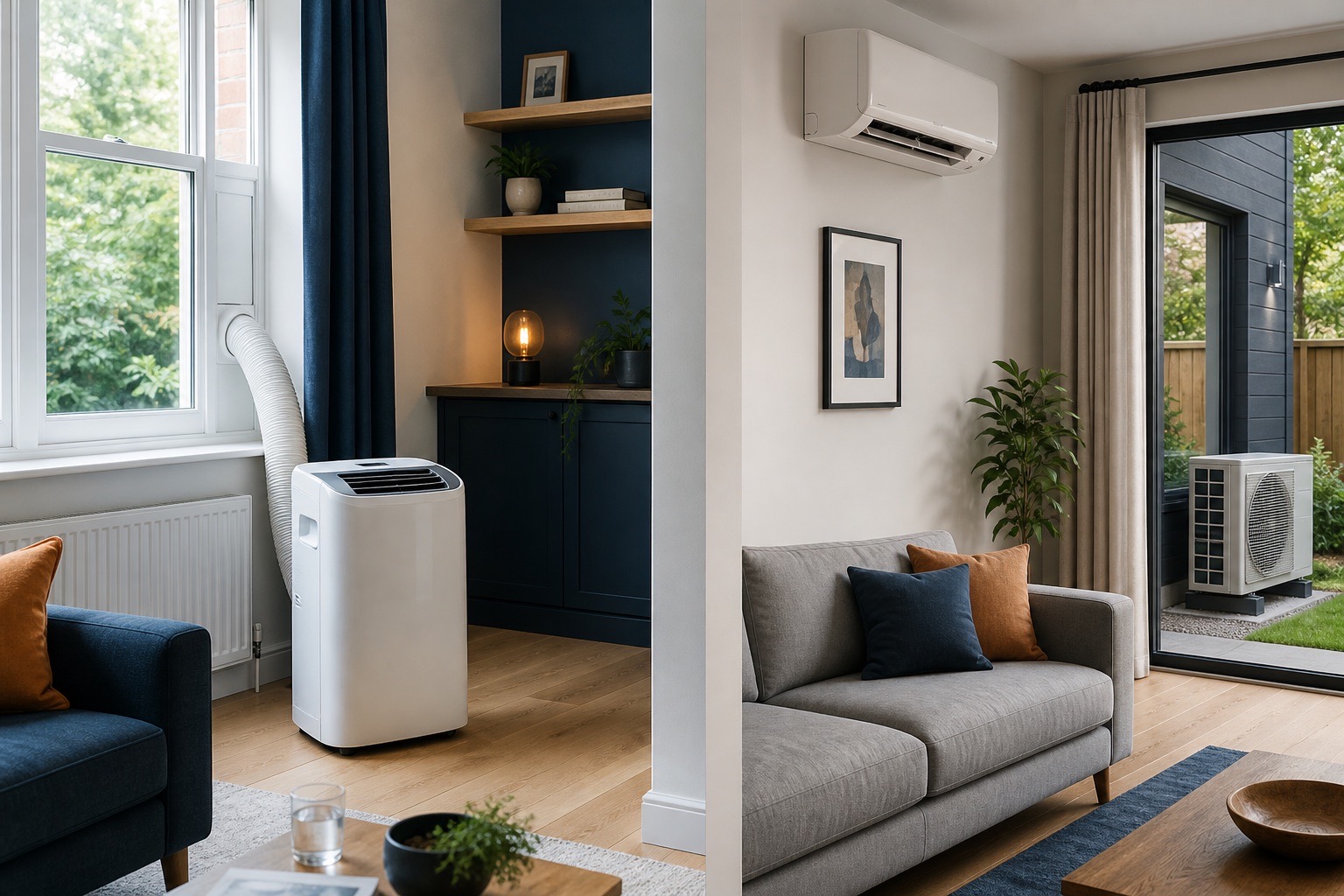
A portable air conditioner is a self-contained plug-in appliance that rejects heat through an exhaust hose. It can be stored and moved, needs no field connection to its refrigerant circuit and is often the practical route where permanent work is unacceptable. It is still a room appliance: window fit, warm-air leakage, floor space and indoor compressor noise shape the result.
An air-to-air heat pump uses one or more indoor fan units connected to an outdoor unit. It can provide efficient space heating and, where the selected system is reversible, cooling. It needs a designed installation, electrical provision, condensate management and qualified refrigerant work. It normally does not produce domestic hot water, so it may form only part of a home's heating transition.
Compare upfront cost on the same scope
Portable cost includes the appliance, delivery and any suitable removable window or door sealing arrangement. Check whether the supplied kit actually fits a UK casement, sash or tilt-and-turn window. An apparently inexpensive unit can be poor value if secure venting needs a custom panel or the room requires a capacity the model cannot provide.
Air-to-air quotations should include every indoor and outdoor unit, brackets or base, pipework, electrical work, controls, drainage, access, commissioning, making good and VAT. In England and Wales an eligible residential installation may qualify for the current £2,500 BUS grant, but compare the net itemised price only after the installer has confirmed the application route.
Noise moves rather than disappears
Portable units keep compressor, condenser fan and evaporator fan indoors. Published minimum sound figures may represent a low fan mode while compressor cycling remains noticeable. In a bedroom, character of sound, vibration and the window panel can matter as much as the stated decibel number. Compare like-for-like test modes and preserve realistic expectations.
A split air-to-air system moves the compressor outdoors, which can make the occupied room quieter, but outdoor sound and vibration need careful siting. A location close to a neighbour's window or a reflective corner can create conflict. Ask for the exact outdoor-unit sound data and the MCS planning-standard assessment where the permitted-development route relies on it.
Running cost depends on service and efficiency
For cooling, compare verified cooling output with electrical input under equivalent conditions. A portable single-hose unit can draw warm replacement air into the room, while a properly installed split system separates indoor and outdoor air paths. Product labels and seasonal efficiency data should be used where applicable, but neither system has one guaranteed household running cost.
An air-to-air heat pump also delivers heating, so an annual comparison must include the heat demand it will serve, seasonal performance and tariff. Do not compare its whole-year electricity with a portable unit used for ten hot evenings. Build separate cooling and heating scenarios, then combine them only when both systems are being assessed for the same services.
Choose by tenure, duration and number of rooms
A renter, occasional user or household with one difficult room may prefer a portable appliance after checking permission, window safety and storage. A homeowner needing regular heating and cooling across several rooms may find a surveyed air-to-air system more coherent. Flats, listed buildings and leasehold homes can require permissions even where planning rules appear favourable.
Use the BTU tool for an initial room range, the window checker for a portable route and the Heat Pump vs Air Con decision engine for a whole-home view. If the result sits at the edge of portable practicality, obtain itemised installation quotations before buying several appliances. The right answer can also be fabric work and shading before either technology.
Map room-by-room demand before comparing capacities
A portable unit and a multi-room air-to-air system should not be compared by adding headline BTU figures alone. First record which rooms need conditioning, when they are occupied and whether doors can remain closed. One portable appliance can be moved between rooms, but it cannot cool two separated rooms simultaneously. A split system can use several indoor units, although the outdoor unit, pipework and controls must be designed for the expected combination of loads rather than selected from a simple room-area rule.
Separate the summer and winter cases. Solar gain, glazing, roof exposure and equipment shape cooling demand, while fabric heat loss, ventilation and the chosen indoor temperatures shape winter demand. Shading, draught reduction and insulation may change both shortlists. Ask a permanent-system designer for room-level calculations and intended operating zones. For the portable route, use the same room facts with the BTU and window-kit tools so a lower purchase price is not achieved by comparing against an undersized or badly vented appliance.
Compare the ownership work after installation
Portable ownership includes storing the appliance, keeping the approved exhaust arrangement usable, cleaning filters and managing condensate in accordance with the manual. The compressor and refrigerant circuit remain factory sealed; damage to that circuit is not a household repair. A split system removes the seasonal hose and floor-space problem but introduces outdoor equipment, fixed drainage, professional maintenance access and refrigerant work that must be performed by appropriately qualified people.
Include permissions, disruption and eventual removal in the comparison. A renter may value reversibility even when a portable unit is louder and less efficient, while an owner planning long-term heating and cooling may accept survey and installation work. Ask who will service the system, what warranty conditions apply and how concealed pipework or penetrations would be made good at replacement. These factors do not produce one universal payback figure, but they expose costs and obligations hidden by an appliance-only comparison.
Compare a one-room purchase with a household service plan
Write the service boundary for each option before comparing prices. For a portable unit, name the room, occupied hours, secure window or door exhaust route, socket, storage position, condensate routine and person able to move or maintain it. For an air-to-air system, mark every room with an indoor unit, every room deliberately left to the existing heating system, the outdoor-unit location, pipe and drain routes, controls, permissions and the separate domestic-hot-water solution. Do not credit a portable product with cooling several closed rooms because it can be wheeled between them, and do not credit one wall unit with whole-home heating because warm air might pass through an open doorway. The comparison should show what happens in the bedroom at night, in other occupied rooms at the same time and during a fault or maintenance visit. That turns a product-versus-product table into an honest map of comfort coverage.
Then test the transition over a representative year. A portable unit may be a bounded response to occasional summer discomfort, especially where tenure or external works rule out a permanent system, but its hose, noise and storage remain recurring ownership tasks. An air-to-air heat pump may provide efficient reversible room conditioning, yet retained boiler, immersion, panel heater or other hot-water and unserved-room costs do not vanish automatically. Ask for separate purchase, installation, servicing and energy scenarios, with every tariff, duty-cycle and seasonal-performance assumption visible. Preserve a fan, shading and safe ventilation plan rather than making either appliance the only defence against heat. If a permanent proposal is chosen, keep existing safe heating available until the new zones, controls and cold-weather behaviour have been demonstrated, unless competent project advice requires a different sequence. The best answer may therefore be a staged path rather than a winner: improve heat control first, protect one priority room if necessary, and commission a designed permanent system only when the household service map and evidence justify it.