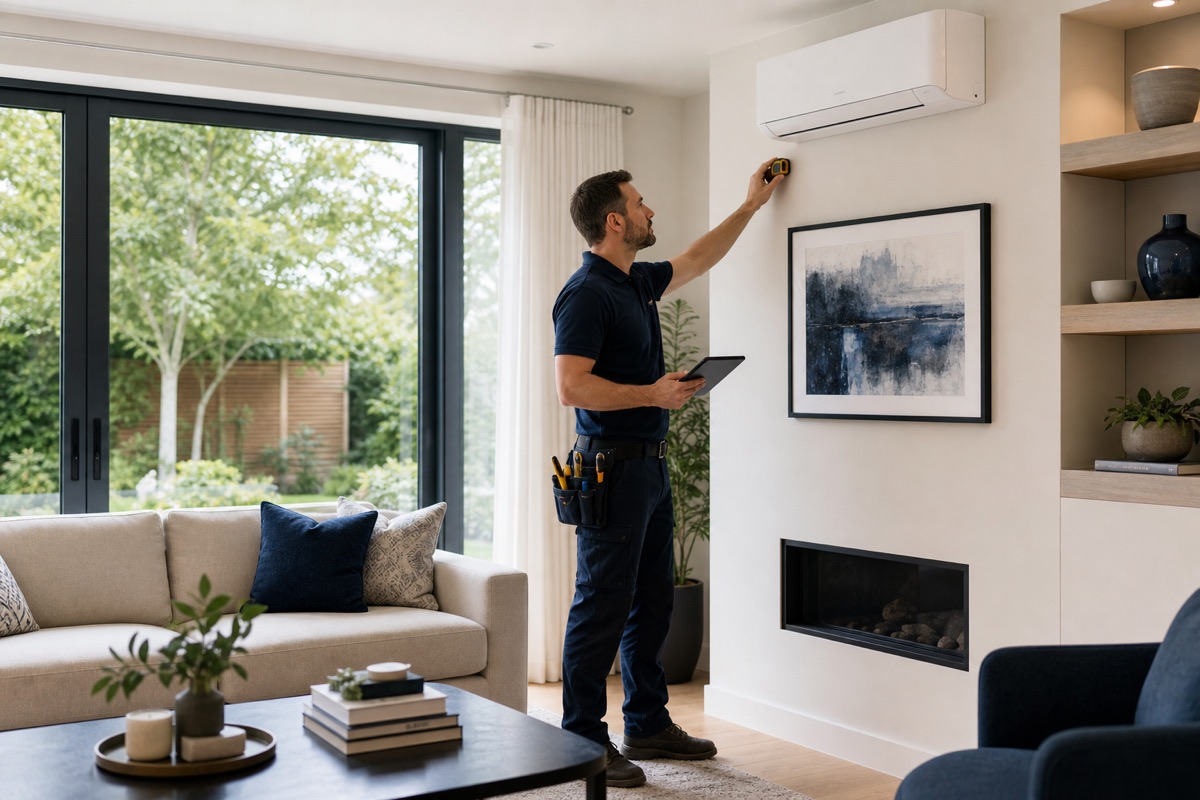
Portable for flexibility; split for regular quieter cooling
Choose a portable unit when one-room cooling, removable setup and no permanent external equipment matter most. Consider a professionally designed split system when regular use, lower indoor noise, heating capability or several rooms justify installation, permission and outdoor-unit planning.
- Portable
- Indoor compressor, window exhaust, no connected refrigerant installation
- Split
- Indoor and outdoor units, permanent work and qualified refrigerant installation
- Deciding factors
- Tenure, room count, noise, frequency of use, permission and whole cost
Compare the decision at a glance
| Decision point | Portable air conditioner | Split or reversible air-to-air system |
|---|---|---|
| Best fit | Occasional cooling in one enclosed room | Regular, quieter or planned multi-room comfort |
| Heat rejection | Window or external-door exhaust hose | Permanent outdoor unit and connected pipework |
| Indoor sound | Compressor remains in the room | Main compressor is normally outdoors |
| Installation | User setup within the manual; no opened refrigerant circuit | Professional design, electrical work and qualified refrigerant installation |
| Heating | Model-specific; may be resistance heat or unverified | Many models are reversible heat pumps; hot water is usually separate |
| Permission | Usually removable, but window security and tenancy rules still matter | Landlord, freeholder or planning checks may apply |
The physical difference matters
A portable air conditioner keeps its compressor, evaporator and condenser in one indoor cabinet. It cools room air and rejects condenser heat through an exhaust hose. The unit can be moved and does not normally need site-connected refrigerant pipework, but it still needs a safe, short route outside, floor space, condensate management and a suitable socket. Portable does not mean vent-free or silent.
A split system places the compressor and condenser outside and connects them to one or more indoor units. Refrigerant pipes, power, controls and a condensate drain cross the building fabric. Moving the major noise source outside can make indoor operation quieter, while variable-capacity models can regulate output more smoothly. The trade-off is a permanent installation, outdoor visual and acoustic impact, permissions and professional design.
Compare comfort in the occupied room
Portable units usually keep the compressor in the room, so the published indoor sound context matters for bedrooms and calls. The exhaust hose also radiates some heat back into the space, and a single-hose unit expels indoor air that must be replaced from elsewhere. A correctly fitted window seal, closed door and sensible hose route are part of performance, not optional accessories to a headline BTU figure.
A split indoor unit mainly contains fans and heat-exchanger components, so its low-fan sound level can be lower than a portable cabinet. However, brochures may quote a quiet minimum rather than the level at high load, and the outdoor unit can affect neighbours. Compare minimum and maximum indoor figures, the outdoor sound-power or pressure basis, operating mode and measurement conditions instead of declaring one technology inaudible.
Efficiency and running cost need the same boundary
Portable running cost can be estimated from verified electrical input, hours and the household unit rate. Actual use changes as the compressor cycles and as heat enters the room. A split system's SEER gives standardised seasonal cooling context, while a reversible system's SCOP describes heating efficiency under a stated climate and test method. None of these values is a guaranteed bill for a specific home.
Compare the service delivered as well as pence per hour. One portable unit used for ten hot nights is a different proposition from a fixed system conditioning several rooms for cooling and winter heating. Include purchase, installation, electrical work, maintenance and expected operating pattern. Do not compare a portable model's maximum input with a split system's seasonal coefficient and call the lower-looking number a saving; the metrics answer different questions.
Property, installation and permission can decide first
A renter or leaseholder may prefer a removable portable setup, but must still avoid damaging the window or creating a security risk. Some fabric seals require an open window and may not suit an unattended ground-floor room. A split system needs written landlord or freeholder approval where the property rights require it, plus an agreed position for the outdoor unit, pipe route, drainage and reinstatement.
Planning rules depend on nation, property and system classification. In England, some air-source heat-pump installations can be permitted development only when every condition is satisfied; Planning Portal guidance also notes that local restrictions can remove those rights. A cooling-only condenser, flat, listed building, conservation area or prominent location deserves a property-specific check. Use the CoolCompare permission tools before treating a salesperson's general statement as approval.
Heating changes the comparison
Many split air conditioners are reversible air-to-air heat pumps: they move heat indoors in winter and outdoors in summer. Energy Saving Trust notes that these systems usually warm air directly and do not normally provide domestic hot water, so a home still needs a water-heating plan. A portable product advertised with 'heat' may instead use resistance heating or may have an unverified claim; classify the mechanism before comparing efficiency.
If regular heating is part of the brief, request a room-by-room heat-loss design, low-temperature performance, defrost explanation and seasonal-cost scenario. Cooling capacity alone cannot confirm winter suitability. Likewise, a portable unit bought for occasional summer relief should not be promoted as a whole-home heating replacement. The CoolCompare finder and heat-pump-versus-air-con tool can frame the route, but an installed design still needs professional evidence.
Single-room and multi-room decisions are different
A portable product can be moved, but moving it also means moving the exhaust arrangement and condensate plan. It will not cool several closed rooms from a hallway. Buying one unit per bedroom increases storage, sockets, window seals and simultaneous electrical demand. If only one room is occupied during a short heatwave, that limitation may be acceptable; write down the actual schedule before assuming whole-home coverage is necessary.
Split choices include separate single-split systems and one outdoor multi-split serving several indoor units. The lowest-equipment-count option is not automatically the best design: diversity, pipe lengths, outdoor capacity, independent room control, minimum output and failure consequences matter. Use the Multi-Room Split Designer for an initial scenario, then ask installers to identify every indoor and outdoor unit and the capacity allocated under simultaneous operation.
Safety, qualifications and quotation evidence
A sealed plug-in portable unit can be positioned, vented and drained by the user according to its instructions. Opening, charging, extending or modifying a refrigerant circuit is different work. GOV.UK guidance says people carrying out specified work on stationary refrigeration, air-conditioning and heat-pump systems containing F gas need the correct qualifications. Ask which person and business will perform that work and how the evidence was checked.
For a split quotation, require exact model numbers, room design loads, pipe and condensate routes, electrical scope, access equipment, commissioning, warranties, waste handling and the price before any grant or discount. Confirm who handles permissions and whether the proposed system is cooling-only or a reversible heat pump. Do not accept an affiliate ranking, an energy label or an installer badge as proof of a complete project design.
A practical choice rule
Choose portable when the need is occasional and room-specific, permanent alterations are not acceptable, a compatible secure exhaust route exists, and indoor noise and floor space are tolerable. Confirm the BTU range, input watts, hose and window kit, drainage, weight and storage before purchase. A fan or shading may be the better first step when the discomfort is mild or no safe exhaust route exists.
Investigate split or reversible air-to-air equipment when cooling is frequent, quieter indoor operation matters, several rooms need planned coverage, or useful winter heating could justify the installation. The final answer remains property-specific. This guide does not provide planning, electrical or legal approval, does not promise a saving and does not establish installer competence; it gives you the evidence categories needed to compare proposals consistently.
Stress-test the choice against how the home may change
Compare both options against more than the current hot room. Write three plausible future briefs: occasional cooling in one occupied room, regular cooling in several rooms, and winter heating as well as summer comfort. Add likely changes in working pattern, family use and tenure, but do not assume every possibility must be funded now. A portable unit can follow the occupied room only if its weight, thresholds, socket, exhaust kit and condensate routine make moving realistic; otherwise “portable” may mean stored in one place. A single split gives one room a permanent solution but cannot automatically serve closed adjoining rooms, while a multi-split makes room combinations and outdoor-unit capacity part of one design. Ask which option remains useful if one bedroom changes to an office, if the household stops needing daytime cooling, or if an outdoor position becomes unacceptable to a neighbour or freeholder.
Then compare the exit and expansion paths. A portable product needs off-season storage, a repeatable secure window setup and an honest disposal route at end of life, but it leaves little building fabric behind. A split system has servicing, access and eventual refrigerant-recovery needs; moving or replacing an outdoor unit can involve permissions, electrical work, pipework and making good. Include planned maintenance access and the household member who will manage each recurring task, because convenience claims often disappear when responsibility is unnamed. If future rooms may be added, ask whether the proposed outdoor unit and pipe routes genuinely support that combination or whether a separate system would be clearer and more resilient. If a move is likely, do not assign an unsupported resale value to installed equipment or assume it can be taken to the next property. Score each route for the use that is reasonably expected, the disruption the household accepts and the evidence available now. This life-change check can justify a modest removable compromise or a designed permanent system, but it prevents a single exceptional summer from silently becoming a whole-home investment plan.
Sources and further reading
Questions answered
Is a split air conditioner always cheaper to run?
Not automatically. Split systems can offer stronger seasonal-efficiency evidence, but the fair comparison must include the same comfort service, operating hours, tariff, purchase, installation and maintenance boundary.
Can one portable air conditioner cool several rooms?
Not reliably through closed doors. A portable unit is normally a one-room product, and moving it also means moving its safe exhaust and condensate arrangement.
Can a split air conditioner heat a UK home?
Many split systems are reversible air-to-air heat pumps and can heat rooms, but suitability needs a room-by-room design and they do not normally provide domestic hot water.