Start with tenure, consent and the whole building
A flat is not simply a small house. Before choosing equipment, identify whether you are a tenant, leaseholder, shared owner or freeholder, then read the tenancy agreement or lease rather than relying on a neighbour's experience. A portable appliance normally avoids permanent external plant, but its hose, window panel and condensate arrangements can still affect security, appearance or the fabric of the building. A drilled wall, fixed pipework or outdoor condenser is an alteration and may also involve common parts.
Ask the landlord, freeholder or managing agent what evidence they require and obtain any consent in writing before ordering an installed system. The Leasehold Advisory Service says that when a lease requires written permission for an alteration, it must be obtained before work starts; its checklist also recommends a written, dated request supported by a clear description, plans or photographs and contractor evidence. Planning permission, building control, lease consent and landlord consent are separate questions: satisfying one does not automatically satisfy the others. The GOV.UK leasehold summary confirms that leases can control alterations, while Planning Portal guidance is introductory and applies to England. Rules and terminology differ elsewhere in the UK, and local restrictions or listed-building controls may apply, so this guide is not legal advice.
Define the room problem before sizing equipment
Record which room overheats, when it happens and what drives it. A top-floor bedroom below a warm roof, a west-facing living room with large glazing and an internal study with computers are different loads even when their floor areas match. Note ceiling height, orientation, usable window openings, occupancy and whether doors normally stay open. The CoolCompare BTU and room-size calculators can create a transparent capacity range, but they cannot inspect insulation, air leakage or heat transfer from adjoining flats.
Treat the result as a shortlist, not a survey or a promise of indoor temperature. An oversized portable unit can still perform poorly if the exhaust leaks hot air back into the room; an undersized unit may run continuously without meeting the comfort goal. Decide whether the need is occasional cooling in one closed room, regular overnight cooling, or year-round heating and cooling. That distinction is more useful than buying the largest advertised BTU figure, and it determines whether a movable product or professional system design deserves attention.
Judge portable air conditioning as a complete window setup
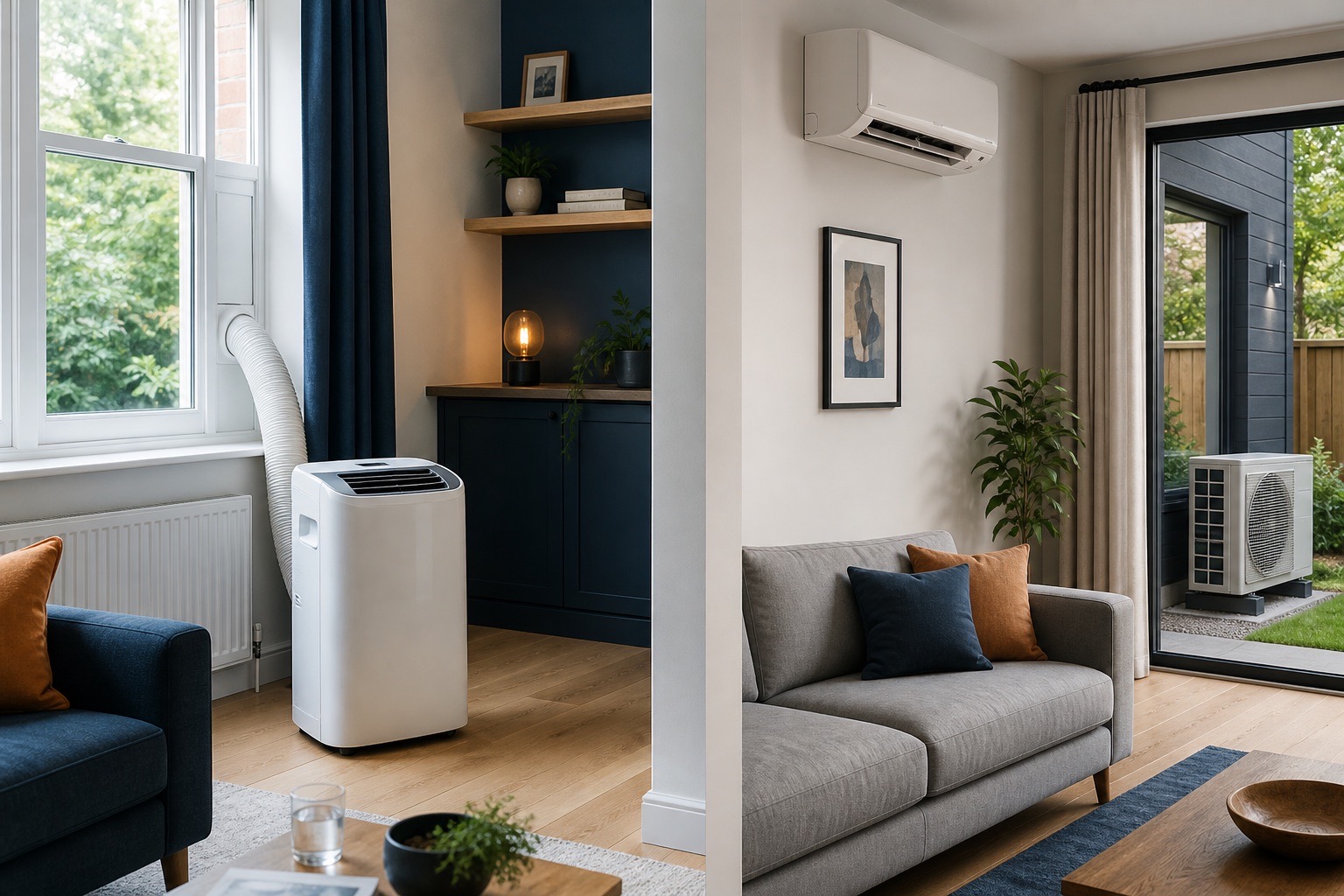
A portable air conditioner is usually the least permanent route for a tenant or leaseholder because the sealed refrigerant circuit remains inside a plug-in appliance. It still needs a correctly sized exhaust route to the outside. Check the actual casement, sash, sliding, tilt-and-turn or roof-window geometry against the supplied kit rather than assuming that the word ‘window kit’ means universal compatibility. The CoolCompare Window Kit Finder can explain the likely sealing challenge, but the appliance manual remains the controlling installation document.
Plan where the unit, hose and power lead will sit with the window secured as far as the arrangement allows. Do not trap or sharply extend a hose beyond manufacturer instructions, improvise a hot-air discharge into a corridor, loft or communal space, or place the unit where it narrows an escape route. Some products collect condensate or require drainage in particular modes; confirm how this is handled without creating a slip hazard or unauthorised discharge. Use a suitable fixed socket and follow the manufacturer's electrical and clearance instructions rather than a casual extension-lead arrangement.
Assess split systems, air-to-air heat pumps and outdoor siting
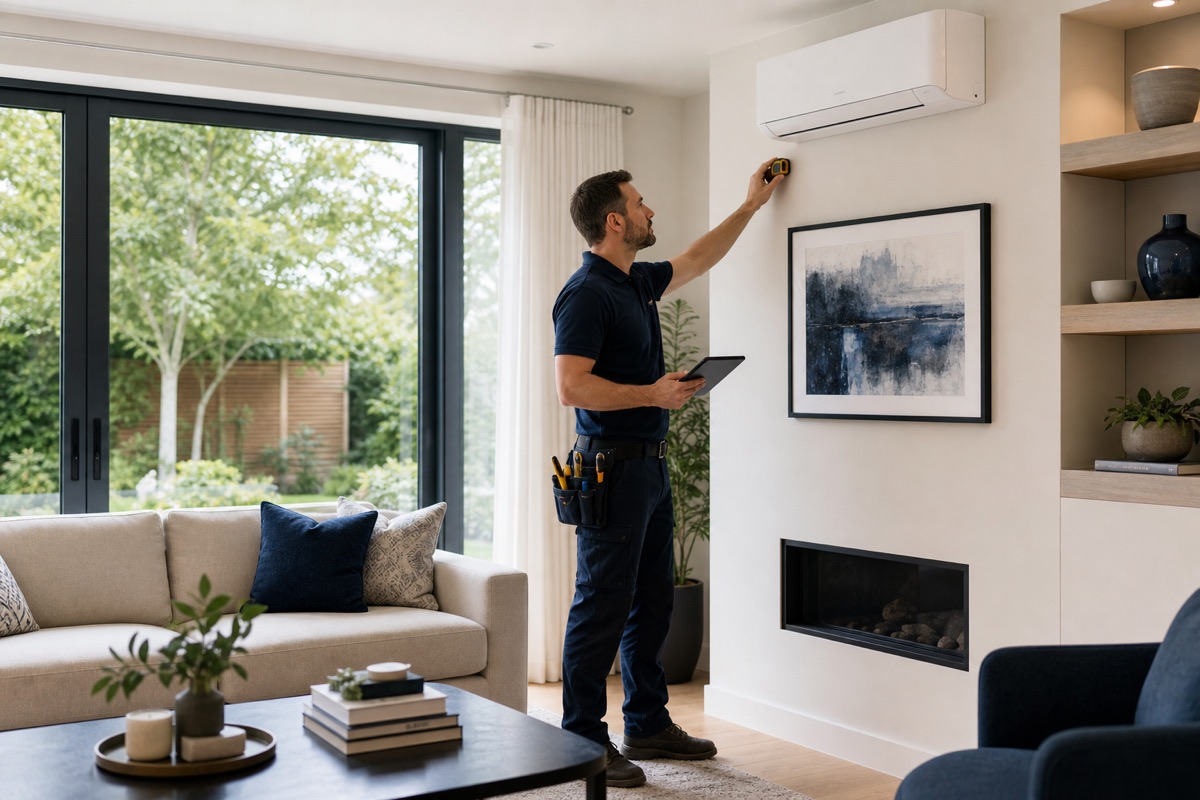
A split air-conditioning system separates the indoor and outdoor components, which can improve space use and avoids a portable exhaust hose. A reversible air-to-air heat pump can also provide heating, whereas a cooling-only split cannot be assumed to do so. Neither label proves that a system suits a particular flat. A competent survey should identify indoor-unit positions, pipe routes, condensate drainage, electrical supply, service access and outdoor-unit support without damaging fire-stopping or concealed services.
Outdoor siting is often the limiting issue. Balconies, roofs, external walls and light wells may be common parts or subject to appearance, structural, access and maintenance restrictions. Planning Portal lists conditions for certain air-source heat-pump installations in England, but even permitted development does not override a lease and its guidance notes that local restrictions can apply. Cooling-only equipment may not follow the same planning route as a qualifying heat pump. Ask the local planning authority and the party controlling the building for project-specific confirmation where the position is uncertain.
Protect neighbours from noise, vibration and condensate
Do not compare indoor sound figures with outdoor-unit figures as though they were measured in the same way. Manufacturer data may be sound pressure or sound power, at different fan speeds and test conditions. Use the CoolCompare noise comparison as translation support, then read the exact data sheet and ask how the proposed location affects the nearest bedroom window, balcony and quiet shared area. A single headline decibel value does not establish night-time acceptability, planning compliance or freedom from structure-borne vibration.
Mounting and pipework details matter as much as the catalogue number. Ask how vibration will be isolated, how the unit will be secured, who can reach it for service, and where defrost or cooling condensate will go. Water must not drip across another flat, stain a facade, freeze on a walkway or create a nuisance below. Request the acoustic or planning evidence used for the design and keep it with the consent record. If a neighbour complaint is already likely, resolve the siting question before paying a deposit rather than after installation.
Keep ventilation, fire safety and refrigerant work separate
Cooling does not replace ventilation. A flat still needs intentional fresh-air and extract arrangements for moisture and pollutants, and the current GOV.UK existing-home ventilation guide for England says that efficiency work must not make ventilation worse. Do not block trickle vents, extract terminals, air bricks or combustion-air openings to improve cooling. Window seals should be removable where necessary and must not defeat required opening, child-safety or escape functions. Seek building or fire-safety advice when a proposal penetrates compartment walls, ceilings or communal areas.
Never open, extend or charge a refrigerant circuit as a DIY task. GOV.UK states that work on stationary air-conditioning and heat-pump equipment containing fluorinated gas requires the correct qualifications. Ask the contractor who will do that work and how their individual and company credentials can be checked. A portable appliance may be positioned and vented by the user only as its instructions allow; damage, refrigerant leakage, unusual odour, repeated electrical tripping or a hot plug is a stop-use issue for the manufacturer, retailer or a competent professional, not an invitation to dismantle it.
Compare the whole decision, not one purchase price
Build a like-for-like shortlist that includes equipment, required window accessories or building work, electrical work, permissions, installation, commissioning, maintenance and reinstatement obligations. For portable units, compare verified rated input, cooling capacity, published sound context, dimensions, weight and hose-kit evidence. For installed systems, compare room-by-room design, exact indoor and outdoor model numbers, heating classification, drainage, warranty and aftercare. The CoolCompare running-cost calculator can apply your tariff and usage scenario, but cycling depends on weather, room load and controls, so it is an estimate rather than a bill forecast.
Use the leasehold Permission Pack to organise the equipment schedule, outdoor location, noise evidence, condensate route, visual impact and installer credentials before seeking consent. Then request itemised installer quotations where a permanent system remains viable. A renter with one hot bedroom may reasonably choose shading, a fan or a well-vented portable unit; an owner with repeated multi-room heating and cooling needs may justify a surveyed split system. The defensible answer is the option that fits the room, permissions and operating pattern, not a universal winner or a claimed saving from an untested home.
Sources and further reading
- GOV.UK: leaseholder rights and responsibilities ↗
- Planning Portal: air-source heat-pump planning permission in England ↗
- GOV.UK: qualifications required to work with F gas ↗
- GOV.UK: existing-home ventilation guide for England ↗
- UKHSA: Beat the Heat home checklist for England ↗
- Leasehold Advisory Service: alterations and home improvements ↗