There is no single UK-wide yes or no
Start with the UK nation, exact equipment, property type and proposed outdoor-unit position. A temporary plug-in portable appliance is different from fixed external equipment; a cooling-only split must not be assumed to qualify for domestic heat-pump permitted development, while a reversible system still has to meet every applicable national, site and property condition.
- Portable appliance
- Usually no fixed condenser, but window safety, lease and tenancy restrictions still matter
- Cooling-only split
- Do not assume domestic air-source heat-pump permitted-development rights apply
- Reversible heat pump
- Check nation-specific use, size, siting, sound, heritage and property conditions
Compare the decision at a glance
| Nation | Published route | Do not overlook |
|---|---|---|
| England | Conditional permitted-development route for qualifying domestic air-source heat pumps; equipment must not be used solely for cooling | MCS 020a, unit number and volume, roof and heritage controls, siting, sound and the exact property type |
| Wales | Since 1 June 2026, qualifying equipment may provide heating or heating and cooling; cooling-only equipment is excluded | MCS 020(a), up to two units at a detached home or one at a non-detached home, 1.5-cubic-metre limit, roof, highway, heritage and amenity controls |
| Scotland | Class 6H can cover qualifying equipment for domestic heating or hot water | Unit number, projection, height, road-facing and designated-land controls, MCS planning standards and listed-building curtilage |
| Northern Ireland | A conditional route exists for some equipment that provides heat within a dwellinghouse curtilage | Boundary separation, prescribed noise standard, unit number, height, roof and prominent siting, and listed-building curtilage |
Start with the nation, property and equipment
There is no reliable UK-wide yes or no. Planning is devolved, permitted-development rights contain nation-specific limits, and local or property-specific restrictions can remove them. Begin with the address, whether the home is a house or flat, its tenure and heritage status, then identify the exact system. A portable plug-in appliance with a temporary window exhaust raises different questions from a fixed condenser, wall openings and permanent external pipework.
Permitted development is a national grant of planning permission only when every relevant limit and condition is met. It is not a general exemption and it does not prove that a particular position is acceptable. A cooling-only split, reversible air-to-air heat pump and air-to-water heat pump may be treated differently. Use official rules current on the proposed installation date and ask the local planning authority for property-specific guidance where any test is uncertain.
England: the 2025 and 2026 changes still have conditions
England amended domestic air-source heat-pump rights in May 2025. Current Planning Portal guidance says an outdoor compressor may be up to 1.5 cubic metres for a house but 0.6 cubic metres for a qualifying block of flats. A detached house can have up to two units under the right; another house or a block of flats is limited to its first installation. From 28 May 2026, the installation must comply with MCS 020a rather than an unspecified equivalent standard.
Other limits remain. Pitched-roof installations are excluded; flat-roof equipment has an edge-distance condition; listed-building curtilage, scheduled monuments, conservation areas, World Heritage Sites and highway-facing positions receive additional controls. Crucially, the equipment must not be used solely for cooling. A reversible air-to-air heat pump may therefore fit the heating-and-cooling condition if every other test is satisfied, while a cooling-only condenser should not be assumed to use this right.
Wales: the 1 June 2026 rules now include heating and cooling
Welsh air-source heat-pump permitted-development rights changed on 1 June 2026. Current GOV.WALES guidance requires compliance with MCS 020(a), allows up to two units at a detached home and one at a non-detached home, and raises the maximum outdoor-compressor volume including housing to 1.5 cubic metres. The equipment must be for heating or heating and cooling; a unit designed for cooling only is excluded.
Other conditions still matter. The right is unavailable where a standalone wind turbine is already within the curtilage, excludes pitched-roof installations and listed houses, controls flat-roof edge distance, and applies specific highway-facing tests inside and outside conservation areas. The unit must be sited to minimise effects on appearance and amenity so far as practicable and removed when no longer needed or capable of microgeneration. Read the live guidance with the 2026 and earlier Orders and ask the local planning authority about the exact proposal.
Scotland and Northern Ireland apply different domestic tests
Scotland's Class 6H guidance allows an air-source heat pump on or within the curtilage of a dwelling, including buildings containing flats, subject to limitations. It generally limits the property to one unit, controls projection, height, road-facing positions and designated land, and excludes World Heritage Sites and listed-building curtilage. The equipment must be for domestic heating or hot water and comply with MCS 020 planning standards or an equivalent, so pure cooling should not be presumed covered.
Northern Ireland's 2023 amendment permits some air-source heat pumps within a dwellinghouse curtilage. Official DfI guidance highlights the one-metre separation from the boundary of another dwelling and a prescribed noise standard; the Order also limits unit number, height, roof siting, prominent positions and listed-building curtilage. Its condition requires the unit to provide heat within the dwellinghouse curtilage. Flats and a cooling-only installation therefore need a specific council check, not a UK average.
Flats, leases, rentals and heritage add separate consent layers
Planning permission and the right to alter a property are separate questions. A lease may reserve external walls, roof, balcony, structure or common parts to the freeholder and may require written licence to alter. A tenant's agreement may prohibit drilling or external equipment. Even where planning permission is not required, proceed only after obtaining every landlord, freeholder, managing-agent or shared-ownership consent required by the documents.
Listed building consent can be needed for work affecting special architectural or historic interest, including less visible fabric changes; conservation-area controls and Article 4 directions may restrict otherwise permitted work. Do not assume a rear condenser, colour-matched trunking or an existing satellite dish settles the issue. Ask the relevant heritage or planning officer what drawings, photographs and method details are needed before placing a non-refundable equipment order.
Noise, appearance and neighbour impact need evidence
An outdoor unit creates fan and compressor sound, and several units can create cumulative effects. MCS 020a provides a sound calculation for qualifying air-source heat-pump permitted development, but passing that method is not a promise of silence or immunity from statutory-nuisance action. Record the exact outdoor model's declared sound data, operating mode, position, reflective surfaces and the relationship to neighbouring habitable-room openings.
A robust proposal also shows the unit's dimensions and housing, mounting or base, pipe and cable route, condensate discharge, screening, access for maintenance and visual effect from public and neighbouring viewpoints. Do not hide the appliance in an enclosure the manufacturer has not approved; restricted airflow can harm performance and alter sound. Ask the installer or acoustic adviser to explain every assumption rather than presenting one unlabelled decibel figure.
Build a written permission pack before signing
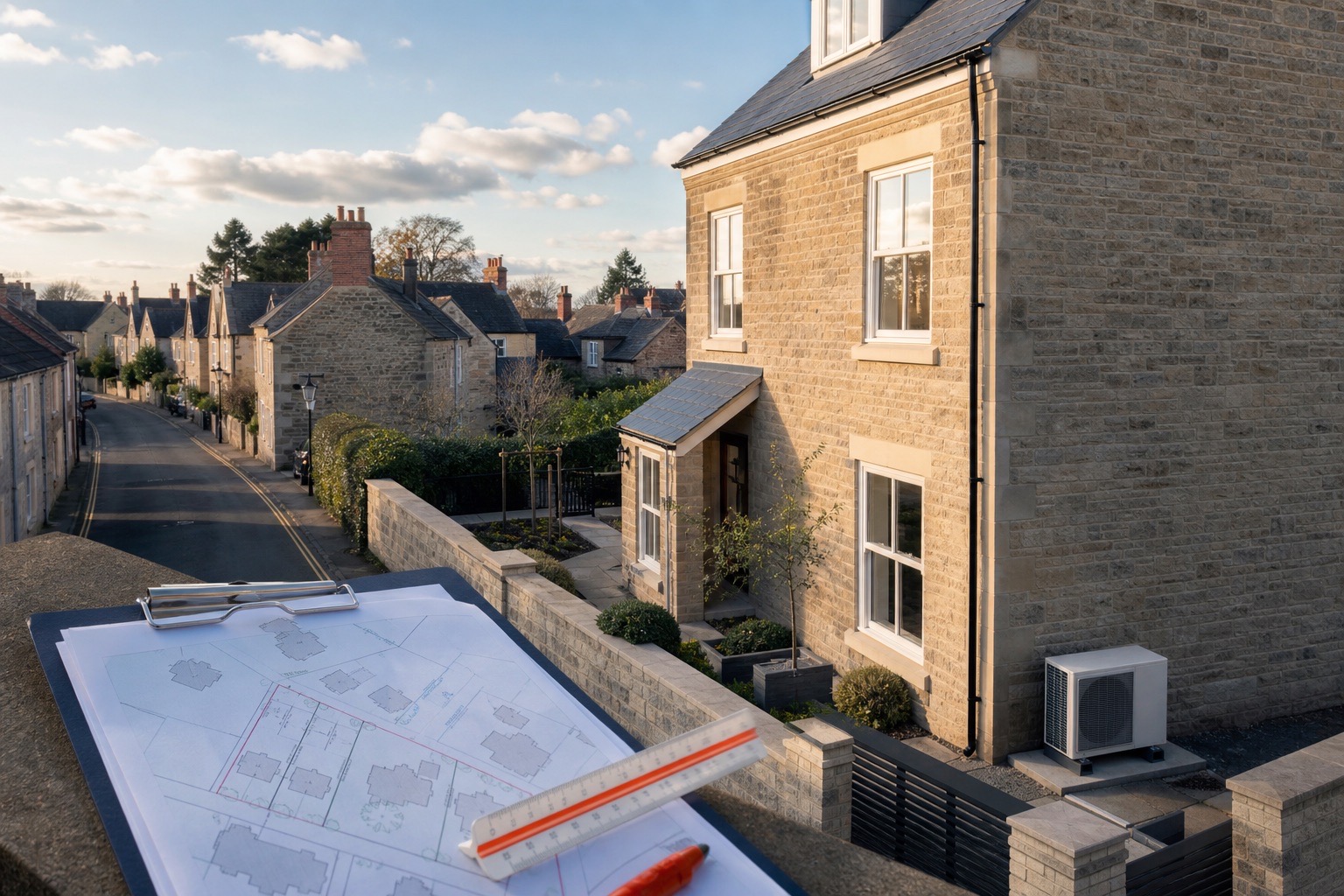
Prepare a scaled location plan, elevations or marked photographs, exact equipment datasheets, outdoor-unit volume, heating-versus-cooling classification, sound calculation where relevant, mounting details, pipework and condensate route, electrical scope and installer credentials. Add copies of freeholder or landlord consent and any local-authority response. The CoolCompare installation-permission checker and flat or leasehold permission pack can organise questions, but they cannot issue permission.
State in the quotation who checks planning, listed-building consent, building regulations, electrical certification and F-gas requirements; who submits an application if needed; and what happens if consent is refused. Keep all approvals and final drawings with the property records. This guide is general information reviewed on 2 September 2026, not legal advice or a certificate of lawfulness. When uncertainty remains, obtain written advice from the relevant local planning authority before work or committed expenditure.
Recheck permission when the equipment or position changes
A planning assessment belongs to an exact proposal, not to the phrase “air conditioning”. Record the indoor and outdoor model combination, whether the system is cooling-only or provides heating, the number and volume of outdoor units, mounting method, elevation, distances, sound evidence, pipe casing and condensate route. These details can affect whether a national permitted-development route is even relevant and whether a local restriction, heritage issue or neighbour impact needs closer review. If a quotation later substitutes a larger condenser, adds another outdoor unit, moves the position around a corner or changes the system from reversible heating and cooling to cooling-only, do not assume the earlier answer travels with it. Ask the installer to highlight every substitution before ordering, and repeat the applicable nation, property and tenure checks against the revised datasheet and drawing. Where a permitted-development condition refers to the installation as a whole, a later change can affect more than the altered component; it deserves a fresh documented pass through every relevant test.
Build change control into the contract. Attach the reviewed equipment schedule and marked elevation to the accepted quotation, state that material changes need the customer’s written approval, and identify who will obtain any revised planning, landlord, freeholder or heritage response. A broad email saying that heat pumps are “normally permitted” is not a model-specific assessment, and an informal conversation should not be presented as a formal decision for the address. At handover, compare the installed location, casing, supports, drainage and exact serial-numbered equipment with the approved pack; retain any local-authority correspondence and the final drawings with the property records. If screening, an enclosure or a different mounting is proposed after a noise complaint, check manufacturer clearances and the permission position again rather than treating it as decoration. This discipline prevents a seemingly minor procurement change from undermining the evidence on which the household committed expenditure, while leaving the local planning authority to determine questions that only it can settle.
Sources and further reading
- Planning Portal: air-source heat-pump planning permission in England ↗
- UK legislation: England air-source heat-pump amendments 2025 ↗
- GOV.WALES: planning permission for domestic heat pumps ↗
- UK legislation: Wales air-source heat-pump permitted-development amendment 2026 ↗
- Scottish Government: householder permitted development for air-source heat pumps ↗
- Northern Ireland DfI: changes to domestic heat-pump permitted development ↗
- UK legislation: Northern Ireland domestic heat-pump amendment 2023 ↗
Questions answered
Does a portable air conditioner need planning permission?
A removable plug-in unit with a temporary exhaust is different from fixed external plant, but the setup can still be restricted by a tenancy, lease, window rules, security or building-safety requirements. Ask before altering glazing, frames, walls or common parts.
Can a cooling-only split use domestic heat-pump permitted-development rights?
Do not assume so. England and Wales expressly exclude cooling-only equipment from the cited domestic heat-pump routes; Scotland requires domestic heating or hot water, and Northern Ireland requires the unit to provide heat. Ask the relevant local planning authority about the exact system and proposal.
Is a reversible air-to-air heat pump automatically permitted development?
No. Its heating capability may be relevant, but every applicable nation-specific, property, size, siting, sound, heritage and use condition still has to be checked for the exact proposal.
Does MCS 020(a) prove that planning permission is unnecessary?
No. Meeting the applicable MCS planning standard is only one condition within a permitted-development route. It does not override the remaining property, number, volume, siting, sound, heritage or local restrictions.
Does freeholder approval replace planning permission?
No. Private consent and statutory approval are separate. A project may need landlord or freeholder approval even when planning permission is not required, and private consent cannot grant planning permission.
Can an installer guarantee that permission is unnecessary?
An installer can supply equipment and site evidence, but the relevant local planning authority determines the planning route. Obtain written property-specific advice or use the nation-appropriate formal route when uncertainty would affect committed expenditure.