Check 1: confirm the Great Britain rule applies to your home
A narrow legal route for compliant plug-in solar devices took effect on 27 August 2026 in England, Scotland and Wales. It changes the rules that previously prevented a generating device from using an approved standard plug and socket. It does not make every portable panel lawful, remove every property restriction or create one rule for the whole United Kingdom. Energy Saving Trust says plug-in solar is not currently legal to use in Northern Ireland, where separate regulations would need to change.
Start with location and tenure before choosing equipment. An owner-occupier with a private garden, suitable electrics and a clear mounting position faces different questions from a tenant, leaseholder or resident in a managed block. Legal electrical connection does not override a lease, tenancy, fire strategy, insurer requirement, listed-building restriction or local planning control. If the seller simply says ‘UK legal’, ask it to identify the exact product specification, Great Britain network route and permissions that apply to the proposed address.
Check 2: verify the exact device, not just an 800 W headline
The rule applies to a complete plug-in solar device that meets the government's current Interim Product Specification, uses the approved manufacturer-supplied plug and satisfies the network connection requirements. A UKCA or CE mark, an 800 W claim or a familiar-looking microinverter is not enough on its own. Check the exact make and model against the Energy Networks Association's Connect Direct device register and follow the product-specific instructions. Similar names, imported variants and marketplace bundles should not be treated as equivalent evidence.
The 800 figure needs careful reading. The final specification limits the device's AC apparent output to 800 VA and 3.5 A; it is not necessarily the total nameplate wattage of the solar modules. Government documents allow combined panel capacity up to 2,000 W DC, while requiring manufacturer advice to seek professional assessment above 960 W DC. More panel capacity can help the inverter reach its capped output in weaker light, but it does not turn the socket into a 2 kW export route. Record both the module-side DC total and the inverter's permitted AC output.
Check 3: keep to one device and exclude plug-in batteries
Current network rules and consumer guidance limit a customer installation to one plug-in solar device—effectively one device per household supply. A device can include more than one panel, as many kits do, but buying two kits does not create permission to plug one into each ring circuit. Do not daisy-chain equipment or rely on a product specification sentence taken out of context. The live G98 connection condition is the controlling network limit, and a flat with its own supply and consumer unit is assessed as its own customer installation.
The new route does not cover plug-in batteries or an integrated plug-in solar-and-storage product. A compliant solar inverter must also stop energising the home circuit when the grid supply is lost, so this is not backup power for a power cut. A property that already has rooftop PV, a hard-wired battery or another generator needs a compatibility and network assessment rather than assuming the new kit can be added automatically. Keep generation, storage and backup claims separate; a seller's shared app or matching case design does not change the legal category.
Check 4: inspect the circuit, protective device and socket
Government laboratory work found representative compliant systems could operate safely under the defined test conditions, but it also found that product quality was not uniform. The result is not a certificate for every home. Energy Saving Trust says not to install where a consumer unit uses old rewireable fuses and recommends professional advice for uncertain wiring, a new or moved socket, outdoor socket work or panel capacity above 960 W DC. A competent electrician should assess older or unknown installations before money is committed.
Electrical Safety First recommends at least a Type A bidirectional RCD protecting the intended circuit and advises that a Type AC-protected circuit should not be used without upgrading. That is expert consumer-safety advice rather than a claim that every Type A label proves the full installation suitable. Ask the assessor to identify the circuit, RCD type and directionality, earthing, socket condition and any other generation already connected. Keep the written result with the product model and registration record instead of relying on a verbal ‘looks fine’ at the point of sale.
Check 5: use a direct socket and a secure outdoor position
The device must connect directly to a suitable socket using its approved plug. Do not use an extension lead, cable reel, multiway adaptor, travel adaptor, plug-in RCD adaptor or altered plug. Those additions introduce connections and cable loads that the compliant system route did not approve. The intended circuit should not be casually shared with hard-wired loads such as a boiler or cooker, and any required outdoor socket should be selected and installed professionally. Follow the manufacturer's cable routing, inspection and shutdown instructions without modifying or repairing the device yourself.
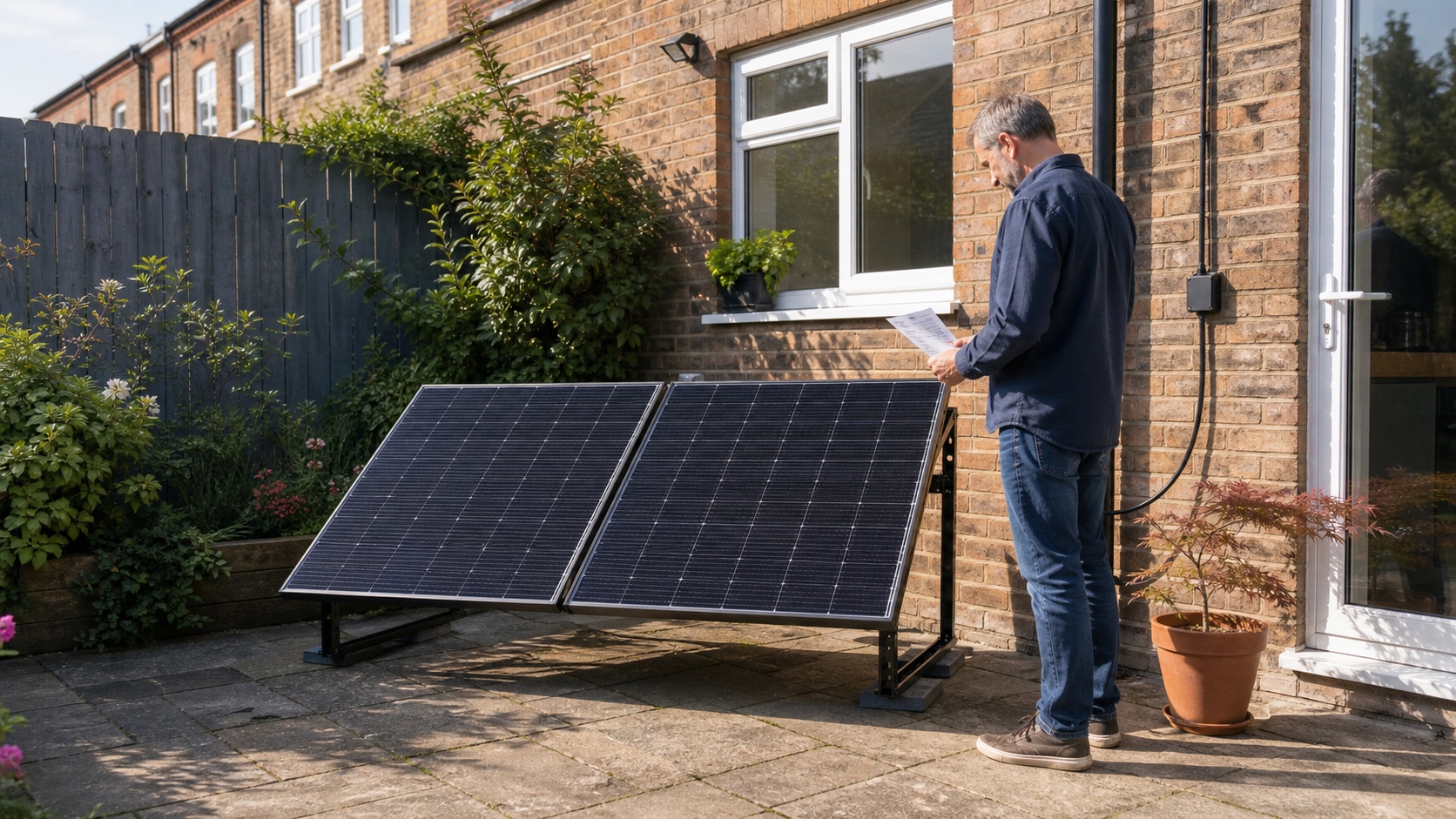
Mechanical safety matters as much as the plug. Panels and frames need a wind-rated, manufacturer-approved mounting arrangement on a stable surface, with drainage, clear access and no obstruction of an escape route. A heavy panel resting against a fence or unsecured on a balcony is not a safe temporary installation. London Fire Brigade advises users to keep combustible material away, avoid damaged equipment and preserve access. Photograph the finished mounting and cable route, then recheck after severe weather; portability does not mean the equipment can be left loose.
Check 6: register the exact model before first use
The household must register the device with its distribution network operator through the approved consumer route at myplugin.solar before use. The process asks for identifying information such as the postcode and exact make and model so the local network knows which microgenerator is connected. Registration is not a retailer stock check, product warranty or permission from a landlord. Likewise, finding a brand on a list is not enough: match the full model identity shown on the equipment and documentation.
Keep the confirmation with the purchase invoice, product specification, serial details and electrical assessment. If the device is removed, replaced or moved to another property, follow the current decommissioning or registration instructions rather than assuming the original record travels with it. Ofgem's G98 decision deals with network safety and operability; it explicitly does not decide product legality, in-home electrical safety or consumer protection. A complete evidence file therefore needs both product compliance and the separate property-side checks.
Check 7: obtain landlord, freeholder and planning permission
Tenants, leaseholders and residents of managed buildings should obtain the required written permission before buying. A landlord, freeholder or building manager may need details of the equipment, fixing method, location, cable route, fire strategy, liability and removal plan. Government guidance encourages case-by-case decisions but does not force an owner or manager to approve. Balcony and external-wall proposals deserve particular care because falling objects, combustible cladding, communal areas and visual changes can sit outside the simple electrical question.
Planning rules also vary by nation and property. England changed permitted-development rules on 27 August, but the route is conditional and excludes certain wooden walls, balconies or enclosures and timber-clad exterior locations. Listed buildings, conservation areas and other designated settings can require additional consent. Scotland and Wales need their own current planning checks. Describe the final frame, dimensions and position to the relevant authority; a seller's photograph of a freestanding kit is not evidence that the same arrangement is lawful at your address.
Check 8: calculate savings from self-use, not the headline
The government says a household could save up to £110 a year and meet up to 20% of average household electricity use. Those are upper scenarios, not a guarantee or a promise to cut the total bill by 20%. Energy Saving Trust models roughly 700 kWh of annual generation for an 800 W system in Manchester, facing south at 30 degrees without shade. Its £70 to £100 range also assumes 2,500 kWh of household use, a 24.7p/kWh tariff and different daytime occupancy patterns. Location, orientation, shade, curtailment and daytime demand change the answer.
A transparent boundary check shows why self-consumption matters. If a system generated 700 kWh and the home used 40% as it was produced, 280 kWh would avoid grid imports; at 24.7p/kWh that is about £69.16. At 60% self-use, 420 kWh would be worth about £103.74. These are CoolCompare arithmetic scenarios, not measured product results. The remaining export should be valued at zero unless an eligible, verified export tariff is in place. Registration alone does not guarantee Smart Export Guarantee payment, and purchase cost, maintenance, product life and any electrical work still belong in the ownership case.
Check 9: decide whether plug-in or rooftop solar fits the job
Plug-in solar can suit a home with a safe ground-level outdoor position, modest daytime base load and no practical route to a full rooftop array. It is smaller, portable and designed for a bounded self-install route when every condition is met. Rooftop solar is a different project: it is professionally designed and installed, normally generates much more energy and may provide stronger evidence for export payments, but it needs a suitable roof, larger budget and more permanent permissions. Compare the service and evidence, not only the advertised watts.
Before paying, complete the nine checks in one record: Great Britain location and tenure; exact registered model; AC and DC ratings; one-device and no-battery limits; wiring, RCD and socket assessment; direct connection and secure mounting; DNO registration; property and planning permissions; and a savings model using actual daytime demand. Stop if any answer depends on a salesperson's unverified assurance. Ask a qualified electrician about uncertain wiring or socket suitability, and obtain property-specific planning or legal advice where permissions are unclear. Use the solar centre and My Home plan to compare plug-in solar with fabric, tariff and rooftop options without double-counting savings.
Sources and further reading
- GOV.UK: plug-in solar legal from 27 August 2026 (published 26 August 2026) ↗
- UK legislation: Plug-in Solar Devices Regulations 2026 (SI 2026/848) ↗
- GOV.UK: final regulatory outcome and Interim Product Specification ↗
- Ofgem: G98 network-code change for plug-in microgeneration (11 August 2026) ↗
- Energy Saving Trust: plug-in solar costs, savings assumptions and legal scope ↗
- Energy Saving Trust: plug-in solar buyer and registration checklist ↗
- Energy Networks Association: approved-device register ↗
- Energy Networks Association: household plug-in solar registration route ↗
- Electrical Safety First: circuit, RCD and direct-connection advice ↗
- London Fire Brigade: plug-in solar safety for residents and homeowners ↗